

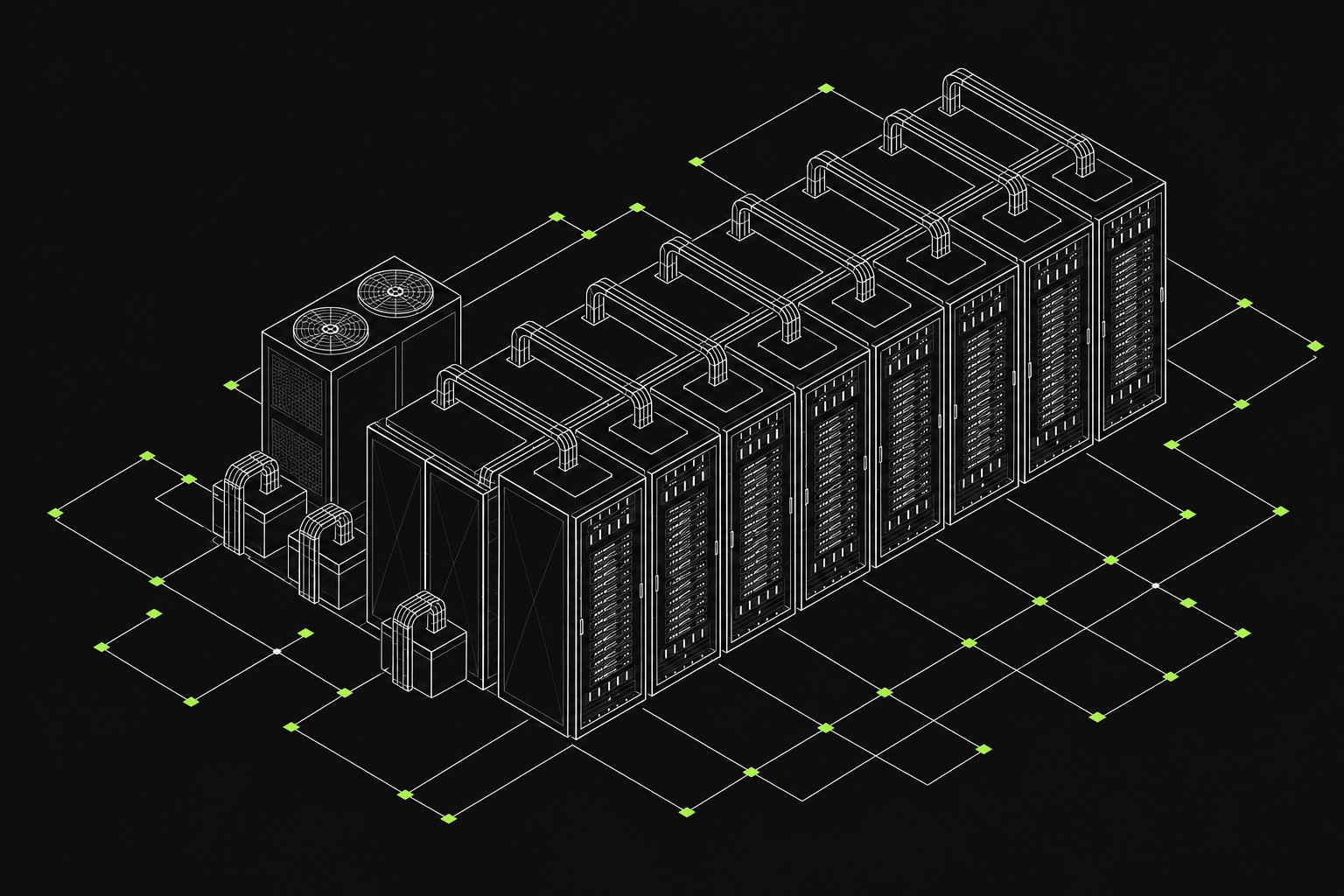
Glossary of AI, GPU and Cloud Terms
A plain-language reference to the language of AI compute infrastructure, GPU technology, cloud gaming and the models that turn AI promise into AI reality.
This glossary defines the core terms used across AI cloud, GPU technology and management, cloud gaming, the as-a-service and neocloud models, and AI models and inference. Terms are grouped into five sections. Definitions are written for a business audience, with brand relevance noted where a term is central to how Radian Arc works.
Contents
1. AI Cloud and Infrastructure
2. GPU Technology and Management
4. GPU-as-a-Service (GPUaaS), AI-as-a-Service (AIaaS) and Neoclouds
1. AI Cloud and Infrastructure
Terms covering where and how AI compute is deployed, from centralized core data centers to the network edge, and the principles of sovereignty and residency that increasingly shape deployment decisions.
Edge computing
Edge computing is the practice of processing data near the point where it is generated rather than sending it to a distant central data center. Edge computing reduces latency and limits how far data travels, which supports both performance and data residency. For Radian Arc, the telco edge is a key deployment model that places GPU compute close to users and devices.
See also: AI compute hub, Latency, Small language model, Inference, Telco edge
Telco edge
The telco edge is the layer of compute deployed inside a mobile or fixed network operator's infrastructure, at sites such as central offices, aggregation points and regional facilities that already sit close to users. Because operators already hold real estate, power and connectivity near population centers, the telco edge offers a route to low-latency compute without building new data centers. For Radian Arc, the telco edge is the primary deployment model for placing GPU capacity close to where data and demand originate.
See also: Edge computing, AI compute hub, In-network services, Latency
Local AI compute
Local AI compute is AI processing that runs on infrastructure within the same country, region or network as the users and data it serves. Keeping inference local shortens the distance each request travels, which lowers latency, and it keeps data inside a defined jurisdiction, which supports residency requirements. Local AI compute is the practical foundation beneath sovereign AI, since control over data depends first on where the processing physically happens.
See also: Edge computing, Data residency, Sovereign AI, AI compute hub
In-network services
In-network services are applications and AI capabilities delivered from inside an operator's own network rather than from a distant third-party cloud. Running services in-network lets an operator use its infrastructure as a service platform rather than only as a connectivity layer, and keeps traffic and data on its own footprint. Cloud gaming, local inference and enterprise AI services are typical in-network workloads.
See also: Telco edge, Cloud gaming, AI compute hub, Inference
Cloud computing
Cloud computing is the delivery of computing resources, including servers, storage and software, over the internet on an on-demand basis. It lets organizations consume infrastructure as a service rather than owning and operating it themselves, paying only for what they use.
See also: Multi-cloud, Edge computing, Hyperscaler
Hyperscaler
A hyperscaler is one of a small number of very large cloud providers that operate global networks of massive data centers and offer broad, centralized services at scale. The hyperscaler model can raise real concerns around cost, data sovereignty and latency for organizations whose data and users sit far from the nearest facility. This is the access and cost gap a neocloud is built to close.
See also: Neocloud, Multi-cloud, Sovereign AI
Data center
A data center is a physical facility that houses the compute, storage and networking hardware used to run digital services. Data centers range from hyperscale facilities operated by the largest providers to smaller modular and edge sites positioned closer to users and devices.
See also: Core data center, Edge computing
Core data center
A core data center is a large, centralized facility built to house high volumes of servers, storage and networking equipment, handling the most demanding workloads such as model training and high-density inference. It sits at one end of a spectrum that runs from centralized core sites through regional hubs to distributed edge locations.
See also: Data center, Edge computing
AI compute hub
An AI compute hub is a localized site, often within a telco network or a regional data center, where GPU infrastructure is concentrated to deliver AI services close to where data and users sit. Positioning compute this way shortens the distance data must travel, supporting lower latency and local control, and Radian Arc helps operators and data center partners turn available site capacity into productive AI compute hubs.
See also: Edge computing, Sovereign AI, Federated network, Telco edge, In-network services
AI factory
An AI factory is a facility or system dedicated to producing AI outputs at scale, applying industrial principles to the generation of intelligence. AI factories can be large and centralized or distributed across edge locations where smaller models serve local needs. The distributed model places AI production closer to the point where data is created and used.
See also: Inference, Tokenomics, Edge computing
Point of Presence (POP)
A Point of Presence, or POP, is a physical location where network and compute equipment is installed to serve a local area, bringing services closer to users and reducing the distance traffic must travel. In an AI context, a POP can host edge compute that supports local inference.
See also: Edge computing, AI compute hub, Latency
Latency
Latency is the delay between a request being made and a response being received, usually measured in milliseconds. Low latency is critical for real-time applications such as cloud gaming and live AI inference, and positioning compute close to users is one of the most effective ways to reduce it.
See also: Input latency, Edge computing, Cloud gaming
Multi-cloud
Multi-cloud is an approach in which an organization uses services from more than one cloud provider, often to avoid lock-in, improve resilience or optimize cost. A multi-environment control plane can route workloads across these clouds, and across on-premises and edge systems, based on need.
See also: AI control plane, On-premises, Hyperscaler
On-premises
On-premises infrastructure is infrastructure that an organization owns and runs inside its own facilities rather than renting from a cloud provider. On-premises deployment offers maximum physical control, which can matter for security and compliance, though it requires capital investment and in-house operation.
See also: Multi-cloud, OPEX, Bare metal
Federated network
A federated network is a model in which multiple independent operators agree to share or route workloads across their infrastructure. Federation lets an AI control plane move inference requests across network boundaries based on available capacity. Radian Arc uses federated agreements across its network of operators to balance workloads and add resilience.
See also: AI control plane, Orchestration, Model routing, Federated intelligence
Federated intelligence
Federated intelligence is the delivery of AI outcomes across a network of independently owned compute sites operating as a single pool of capacity. A federated network describes the agreements between operators. Federated intelligence describes the capability those agreements unlock, which is the routing of each inference request to the site best placed to serve it on latency, cost and sovereignty grounds. It depends on a control plane with visibility across the full federation.
See also: Federated network, AI control plane, Model routing, Sovereign AI
Data residency
Data residency is the principle that data is stored and processed within a defined geographic or legal boundary. Data residency requirements are common in regulated sectors and the public sector, where information cannot lawfully leave a country or region. Processing data on local infrastructure is a direct way to meet these requirements, which is why residency is often one of the first sovereignty questions an organization needs answered.
For the deeper regulatory thesis, see the Radian Arc point of view on sovereign AI.
See also: Data sovereignty, Sovereign AI, Confidential computing, Local AI compute
Data sovereignty
Data sovereignty is the principle that data is subject to the laws and governance of the country in which it is collected or stored. Sovereignty extends beyond residency, which concerns where data sits, to cover who can access, control and make decisions about that data. Processing information on local infrastructure helps organizations meet sovereignty obligations by keeping data inside jurisdictional borders.
For the deeper thesis, see the Radian Arc point of view on sovereign AI.
See also: Sovereign AI, Data residency, Confidential computing, Federated network, Collaborative sovereignty
Sovereign AI
Sovereign AI is an approach in which a country or organization retains control over the infrastructure, data and models that power its AI capabilities, keeping them within its own legal and geographic boundaries. Sovereign AI is best understood as local control, in-country deployment and data-residency readiness rather than as any absolute guarantee, and is driven by the need for data residency, resilience and domestic digital capability. Radian Arc enables sovereign AI by deploying GPU compute close to where data and users sit.
For the deeper thesis and implementation detail, see the Radian Arc point of view on sovereign AI and the sovereign AI stack overview.
See also: Data sovereignty, Data residency, AI control plane, Edge computing, Local AI compute
Collaborative sovereignty
Collaborative sovereignty is an approach in which organizations or countries retain control over their own data and infrastructure while still sharing capacity and capability with trusted partners. It recognizes that few operators can meet peak AI demand from their own footprint alone, and that federation across independent parties can add resilience without surrendering local control. Each participant keeps authority over what crosses its own boundary.
See also: Sovereign AI, Federated network, Federated intelligence, Data sovereignty
Workload
A workload is a discrete computing task or application that consumes infrastructure resources. Workloads vary widely in their demands, since model training, real-time inference and cloud gaming each place different requirements on compute, memory and latency. Matching every workload to the most suitable location and hardware is central to efficient AI infrastructure.
See also: Orchestration, Training, Inference, Model routing
FAQs
What's the difference between data sovereignty and data residency?
Data residency concerns only where data physically sits. Data sovereignty goes further, covering who can access, control and make decisions about that data under the laws of the country where it is held.
What is edge computing?
Edge computing is the practice of processing data near where it is generated rather than sending it to a distant central data center, reducing latency and supporting data residency.
2. GPU Technology and Management
The hardware and operational concepts behind high-performance AI compute, from the silicon itself through to cooling, orchestration and the efficiency metrics that determine how much useful output each GPU delivers.
GPU (Graphics Processing Unit)
A GPU, or Graphics Processing Unit, is a processor designed to perform many calculations in parallel, which makes it well suited to the mathematics behind AI and graphics rendering. GPUs are the core engine of both AI inference and cloud gaming. How a GPU is clustered, cooled and orchestrated determines how much of that raw hardware translates into useful, monetizable output rather than idle capacity. Sourcing, deploying and optimizing GPUs efficiently is central to Radian Arc's business.
See also: GPU memory, Cluster, Superchip, GPU-as-a-Service
CPU (Central Processing Unit)
A CPU, or Central Processing Unit, is the general-purpose processor that handles the broad range of tasks in a computer system. In AI infrastructure, CPUs work alongside GPUs, managing coordination, data preparation and tasks that do not require massive parallel processing.
See also: GPU, Superchip, Interconnect
Fabrication process
A fabrication process is the manufacturing technology used to produce a chip, measured in nanometers (nm). A smaller process node, such as 3nm, places more transistors in the same area, improving performance and efficiency, and each new generation of AI silicon depends on advances in fabrication.
See also: GPU, Superchip, GPU memory
GPU memory
GPU memory is the high-speed memory attached to a GPU that holds the data and model parameters it is actively working on, commonly built on high-bandwidth memory (HBM) technology. The amount and speed of this memory determine how large a model a GPU can run and how quickly it can run it.
See also: GPU, Quantization, Superchip
Interconnect
An interconnect is the high-speed technology that links GPUs, CPUs, memory and storage so they can exchange data quickly. Fast interconnect prevents bottlenecks and ensures that expensive compute does not sit idle waiting for data.
See also: Superchip, Cluster, GPU memory
Superchip
A superchip is a tightly integrated package that combines GPU, CPU, memory and interconnect technology, often on a single module. Superchips enable unified memory and very fast data movement between components, supporting higher density and efficiency for AI workloads.
See also: GPU, Interconnect, GPU memory
GPU Cluster
A GPU cluster is a group of servers, often containing many GPUs, connected to work together as a single system, providing the combined compute power needed for large AI workloads. How a cluster is designed, cooled and orchestrated determines how much useful output it delivers.
See also: Orchestration, Utilization, Interconnect, Superchip
Rack
A rack is a standardized frame that houses multiple servers in a data center. Rack design affects how much compute can be installed, how it is powered and how heat is managed. Dense AI deployments require racks engineered for high power draw and advanced cooling.
See also: Compute density, Cluster
Compute density
Compute density is the amount of processing power packed into a given physical space, whether a single chip, a server or an entire facility. Higher density, often described as high-density compute, delivers more performance per square meter but generates more heat.
See also: Direct liquid cooling, Immersion cooling, Rack, Cluster
Direct liquid cooling (DLC)
Direct Liquid Cooling, or DLC, is a cooling method that circulates liquid directly to the hottest components, such as GPUs and CPUs, removing heat far more efficiently than air. DLC supports the high compute density that modern AI hardware demands, allowing more chips, servers and racks per facility.
See also: Compute density, Immersion cooling, Rack
Immersion cooling
Immersion cooling is a technique in which servers are submerged in a non-conductive fluid that absorbs heat directly. Immersion cooling supports high-density AI hardware, can be deployed in compact spaces and is well-suited to edge sites where traditional air cooling is impractical.
See also: Compute density, Direct liquid cooling, AI compute hub
Power Usage Effectiveness (PUE)
Power Usage Effectiveness, or PUE, is a standard metric for data center energy efficiency, calculated as total facility energy divided by the energy delivered to computing equipment. A PUE closer to 1.0 indicates more of the energy drawn is going into useful compute rather than overhead such as cooling. PUE is a facility-level companion to Intelligence per Watt's focus on useful output.
See also: Intelligence per Watt, Utilization
GPU Orchestration
GPU orchestration is the intelligent scheduling and management of workloads across available compute resources. Effective GPU orchestration keeps hardware busy with high-value work, batches requests efficiently and reduces wasted energy on idle chips or inefficient data transfers, making it a key lever for maximizing Intelligence per Watt.
See also: AI control plane, Utilization, Intelligence per Watt, Model routing
GPU Utilization
GPU utilization is the proportion of available compute capacity that is actually doing useful work. Low utilization wastes both capital and energy, since idle GPUs still draw power and incur cost. Driving high utilization across distributed infrastructure is central to converting GPU compute into commercial outcomes.
See also: Orchestration, Tokenomics, Intelligence per Watt
Intelligence per Watt
Intelligence per Watt is a measure of how much useful AI output is produced for each unit of energy consumed. As AI shifts from training toward inference, Intelligence per Watt becomes a more meaningful performance metric than raw cluster size. This is the metric that ties tokenomics, orchestration and utilization together into a single measure of whether a fleet of GPUs is doing useful work or just consuming power. Radian Arc optimizes at the silicon, software and orchestration layers to maximize the useful, token-generating output of every Watt.
See also: Tokenomics, Orchestration, Utilization, Inference
FAQs
What's the difference between a GPU and a CPU?
A GPU performs many calculations in parallel, which suits the mathematics behind AI and graphics. A CPU is the general-purpose processor that handles coordination and data preparation alongside it.
Why does Intelligence per Watt matter more than raw cluster size?
As AI workloads shift from training toward inference, the useful output produced per unit of energy becomes a more meaningful measure of performance than how large a cluster is on paper.
What is GPU utilization and why does it matter?
GPU utilization is the proportion of available compute capacity doing useful work. Low utilization wastes both capital and energy, since idle GPUs still draw power and cost money.
3. Cloud Gaming
The concepts behind streaming high-performance games from remote GPUs to any device, and the commercial mechanics, such as user acquisition and carrier billing, that make cloud gaming a viable service for operators.
Cloud gaming
Cloud gaming is a model in which games run on remote GPU servers and are streamed to the player's device as video, with player inputs sent back in real time. It removes the need for expensive local hardware and depends on high-performance, low-latency compute positioned close to users. For Radian Arc, cloud gaming is the first monetizable workload that proves out edge GPU infrastructure.
For the operator platform this powers, see the RadianX cloud gaming offer.
See also: Pixel streaming, White-label, Carrier billing, Edge computing, First monetizable workload, In-network services
Pixel streaming
Pixel streaming is the technique of rendering graphics on a remote server and streaming the resulting video to a user's device. It underpins cloud gaming and other interactive applications by shifting the heavy processing from the device to the GPU in the network.
See also: Cloud gaming, GPU, Frame rate
First monetizable workload
A first monetizable workload is an application that generates revenue from newly deployed infrastructure early in its life, helping fund the wider build-out behind it. The concept matters in AI infrastructure because GPU capacity is expensive to stand up and can sit underused while longer-term enterprise demand develops. Radian Arc positions cloud gaming as the first monetizable workload on operator infrastructure, with AI inference and enterprise services following on the same GPU estate.
See also: Cloud gaming, Utilization, Carrier billing, Tokenomics
AAA title
An AAA title is a high-budget, high-production-value video game, typically from a major studio. AAA titles demand powerful graphics hardware, which historically meant a console or gaming PC. However, cloud gaming makes these titles playable on lower-powered devices by running them on remote GPUs.
See also: Cloud gaming, Pixel streaming, Frame rate
Frame rate (FPS)
Frame rate, or FPS, is the number of images displayed per second, measured in frames per second. Higher frame rates produce smoother motion, which matters for fast-paced games. Maintaining high frame rates over a stream requires capable GPUs and an efficient encoding and delivery pipeline.
See also: Cloud gaming, Bitrate, Pixel streaming
Bitrate
Bitrate is the amount of data used to encode each second of streamed video, with a higher bitrate improving image quality but requiring more bandwidth. Cloud gaming balances bitrate, resolution and latency to deliver a smooth experience over real-world networks.
See also: Cloud gaming, Pixel streaming, Input latency
Input latency
Input latency is the delay between a player's action and the on-screen response. In cloud gaming, input latency includes the round trip from the device to the server and back, so proximity between the player and the GPU is critical to a responsive experience.
See also: Cloud gaming, Latency, Edge computing
White-label
A white-label product or service is one produced by one company and rebranded by another to sell as its own. White-label cloud gaming lets an operator offer a branded service to its customers while the underlying infrastructure and platform are provided by a partner.
See also: Cloud gaming, Carrier billing, User acquisition
Carrier billing
Carrier billing is a payment method that lets users charge purchases to their mobile or broadband account rather than to a card. Carrier billing simplifies sign-up and payment for telco-delivered services, which can lift conversion for cloud gaming and other digital products sold through an operator.
See also: Cloud gaming, White-label, User acquisition
User acquisition (UA)
User acquisition is the marketing process of attracting and converting new users to a product or service. In cloud gaming, effective UA combines a clear user pathway, a billing route and marketing budget. Radian Arc supports operators with demand generation and user acquisition as part of its cloud gaming offer.
See also: Carrier billing, Cloud gaming, White-label
FAQs
What is cloud gaming?
Cloud gaming is a model in which games run on remote GPU servers and are streamed to a player's device as video, removing the need for expensive local hardware.
What's the difference between pixel streaming and cloud gaming?
Pixel streaming is the underlying technique of rendering graphics remotely and streaming the video output. Cloud gaming is the specific application of that technique to deliver playable games.
What is carrier billing and how does it help cloud gaming?
Carrier billing lets users charge purchases to their mobile or broadband account rather than a card, simplifying sign-up and payment in a way that can lift conversion for cloud gaming and other operator-delivered services.
4. GPU-as-a-Service (GPUaaS), AI-as-a-Service (AIaaS) and Neoclouds
The service and commercial models through which GPU and AI capacity is consumed, and the new category of providers, the neoclouds, that have emerged to serve AI demand alongside the established hyperscalers.
Neocloud
A neocloud is a newer category of cloud provider focused specifically on GPU and AI compute, as distinct from the broad service catalogs of the established hyperscalers. Neoclouds compete on access to the latest GPUs, on performance and on price. Radian Arc differentiates by combining infrastructure with orchestration, sovereignty and monetizable applications rather than offering raw capacity alone.
See also: Hyperscaler, GPU-as-a-Service, Sovereign AI, AI control plane
GPU-as-a-Service (GPUaaS)
GPU-as-a-Service, or GPUaaS, is the provision of GPU compute capacity on-demand, charged by usage rather than owned outright. It lets organizations scale AI and graphics workloads on an operating expenditure basis, reducing the upfront investment needed to launch AI or gaming services, and is typically delivered from dedicated capacity with optional value-added services on top.
For the commercial platform, see the InferX GPU-as-a-Service offer.
See also: AI-as-a-Service, Neocloud, NVIDIA Cloud Partner, OPEX
AI-as-a-Service (AIaaS)
AI-as-a-Service, or AIaaS, is the delivery of AI capabilities, from infrastructure through to managed models and applications, as an on-demand service. It lets organizations access AI outcomes without building and operating the full stack themselves. InferX provides AIaaS spanning dedicated GPU capacity through to end-to-end managed AI services.
For the commercial platform, see the InferX AIaaS offer.
See also: GPU-as-a-Service, Inference-as-a-Service, Model-as-a-Service, AI control plane
Inference-as-a-Service
Inference-as-a-Service is a service model that provides ready-to-use AI inference capacity, letting customers run models and pay per use without managing the underlying infrastructure. It is a focused form of AIaaS centered on the production stage of AI, rather than the full spectrum of AI capability.
See also: Inference, AI-as-a-Service, Model-as-a-Service
Model-as-a-Service (MaaS)
Model-as-a-Service, or MaaS, is the delivery of trained AI models through an interface or API, so customers can use them without hosting or maintaining the models themselves. The provider handles the infrastructure, scaling and updates behind the model.
See also: AI-as-a-Service, Inference-as-a-Service, Large language model
NVIDIA Cloud Partner (NCP)
NVIDIA Cloud Partner, or NCP, is a formal designation for cloud providers that meet NVIDIA's standards for deploying and operating its GPU platforms. NCP status signals credibility and access within the NVIDIA ecosystem. InferX holds NVIDIA Cloud Partner status.
See also: GPU-as-a-Service, AI-as-a-Service
OPEX (operating expenditure)
OPEX, or operating expenditure, means paying for infrastructure as an ongoing service rather than buying it outright. As-a-service models let organizations consume GPU compute on an OPEX basis, which reduces the upfront investment required to launch AI or gaming services.
See also: CAPEX, GPU-as-a-Service, On-premises
CAPEX (capital expenditure)
CAPEX, or capital expenditure, means buying infrastructure assets upfront rather than paying for them as an ongoing service. This is the traditional route to owning compute outright, and it carries a materially different risk and cash flow profile than consuming the same capacity on an OPEX basis.
See also: OPEX, On-premises, Long-term capacity agreement
Long-term capacity agreement (offtake)
A long-term capacity agreement, often called an offtake agreement, is a commercial arrangement in which a provider commits to take or supply a defined volume of compute capacity over an extended period. This model underpins the financing and planning of large GPU deployments, distinct from a data center lease offtake, which concerns physical space rather than compute itself.
See also: GPU-as-a-Service, Neocloud
Bare metal
Bare metal refers to dedicated physical servers provided to a single tenant without a virtualization layer. This gives direct access to hardware for maximum performance and control, which can be preferred for demanding AI and gaming workloads.
See also: GPU-as-a-Service, Multi-tenancy
Multi-tenancy
Multi-tenancy is an architecture in which a single pool of infrastructure securely serves multiple customers, with each tenant's data and workloads kept isolated. It improves utilization and cost efficiency, while isolation preserves security and privacy.
See also: Bare metal, Utilization, Confidential computing
Independent Software Vendor (ISV)
An Independent Software Vendor, or ISV, is a company that develops and sells software, often built to run on a particular platform or infrastructure. ISVs are important partners in an AI ecosystem, supplying the applications and models that run on GPU infrastructure.
See also: Model-as-a-Service, AI-as-a-Service
FAQs
What is GPU-as-a-Service?
GPU-as-a-Service is the provision of GPU compute capacity on demand, charged by usage, letting organizations scale AI or graphics workloads without large upfront capital investment.
What's the difference between AIaaS and GPUaaS?
GPUaaS provides raw GPU compute capacity on demand. AIaaS goes further, delivering AI capabilities from infrastructure through to managed models and applications as a single on demand service.
What's the difference between a neocloud and a hyperscaler?
A hyperscaler operates a broad, centralized service catalog at global scale. A neocloud focuses specifically on GPU and AI compute, competing on access, performance and price rather than breadth of service.
5. AI Models and Inference
The models that produce AI outputs and the process of running them in production. These terms cover the spectrum from large frontier models to compact local models, and the control and optimization techniques that route work to the most efficient destination.
Inference
Inference is the stage at which a trained AI model is put to work, generating outputs such as predictions, text or decisions in response to new inputs. Inference is the production phase of AI, and unlike one-time training it runs continuously, so as workloads shift from training toward inference, low-latency and cost-efficient compute close to users becomes increasingly important.
See also: Training, Inference-as-a-Service, Edge computing, Tokenomics
Artificial intelligence (AI)
Artificial intelligence, or AI, is the field of building systems that perform tasks normally associated with human intelligence, such as understanding language, recognizing images and making predictions. Modern AI is dominated by machine learning, where systems learn patterns from data rather than following hand-written rules.
See also: Machine learning, Generative AI, Large language model
Machine learning
Machine learning is a branch of AI in which systems learn patterns from data and improve their performance without being explicitly programmed for each case. Machine learning underpins most current AI, from language models to image recognition.
See also: Artificial intelligence, Training, Fine-tuning
Generative AI
Generative AI is a category of AI that creates new content, such as text, images, audio or code, in response to prompts. Generative AI is powered largely by large language models and other foundation models, and it is a major driver of demand for inference compute.
See also: Large language model, Inference, Token
Large language model (LLM)
A large language model, or LLM, is an AI model trained on very large volumes of text to understand and generate language. LLMs power many generative AI applications. They are typically developed and trained in large core data centers because of the scale of compute required.
See also: Generative AI, Small language model, Training, Token
Token
A token is the basic unit of text that a language model processes, roughly a word or part of a word. The cost and speed of running a model are commonly measured in tokens, and the number of tokens a given GPU can produce is a key measure of efficiency.
See also: Tokenomics, Inference, Large language model
Training
AI training is the compute-intensive process of teaching an AI model by exposing it to large volumes of data so it can learn patterns. Training typically takes place in large core data centers, and once a model is trained, it moves into inference, where it is used in production.
See also: Inference, Large language model, Core data center, Fine-tuning
Fine-tuning
Fine-tuning is the process of taking a pre-trained model and further training it on a focused dataset so it performs better on a specific task or domain. It is often more practical and cost-effective than training a model from scratch.
See also: Training, Small language model, Quantization
Confidential computing
Confidential computing is a set of technologies that protect data while it is being processed, not only when it is stored or transmitted, by isolating it within a secured hardware environment. This supports privacy and sovereignty in shared or distributed infrastructure, reinforcing the wider sovereignty cluster rather than standing apart from it.
See also: Data sovereignty, Multi-tenancy, Sovereign AI
Quantization
Quantization is a technique that reduces the numerical precision of a model's calculations to make it smaller and faster to run, usually with minimal loss of accuracy. This helps models run efficiently on constrained or edge hardware, and applied on top of an already compact small or tiny model, it pushes edge viability even further.
See also: Small language model, GPU memory, Tiny model
Retrieval-augmented generation (RAG)
Retrieval-augmented generation, or RAG, is a method that lets an AI model draw on an external source of information at the moment of a request, improving accuracy and allowing responses grounded in current or private data. RAG is widely used to apply general models to specific organizational knowledge without retraining the model itself.
See also: Fine-tuning, Inference, Large language model
Small language model (SLM)
A small language model, or SLM, is a compact language model trained or tuned for a narrower set of tasks. SLMs require less compute than large models, which makes them well-suited to edge deployment and to localized applications trained on specific local needs.
See also: Large language model, Edge computing, Tiny model, Quantization
Tiny model
A tiny model is a very small, highly focused model designed to deliver a specific outcome at minimal compute cost. A tiny model approach, combined with intelligent orchestration, can deliver the required result using fewer GPUs than a large general-purpose model. This is a core part of how Radian Arc optimizes cost and output.
See also: Small language model, Tokenomics, Quantization
Frontier model
A frontier model is one of the largest and most capable general-purpose AI models, typically developed by a handful of well-resourced organizations. Frontier models are powerful but can be costly to run. An AI control plane can decide when a frontier model is justified and when a smaller model delivers the required outcome more efficiently.
See also: Model routing, AI control plane, Small language model
Model routing
Model routing is the practice of directing each AI request to the most appropriate model and location rather than sending everything to a single model. It weighs accuracy, cost, latency and sovereignty to deliver the best outcome for each request, and is a core function of an AI control plane.
See also: AI control plane, Frontier model, Small language model, Tokenomics
AI control plane
An AI control plane is the intelligent layer that decides when, where and how AI workloads run across available infrastructure, routing each inference request to the most suitable destination based on factors such as latency, cost, data sovereignty and model accuracy. The InferX AI control plane is central to Radian Arc's approach to solving this problem, routing workloads across edge nodes, core data centers and frontier models to maximize Intelligence per Watt.
For the commercial platform, see the InferX control plane product page.
See also: Model routing, Orchestration, Frontier model, Intelligence per Watt, Federated network
Tokenomics
Tokenomics, in the AI-compute sense and distinct from cryptocurrency tokenomics despite the shared vocabulary, is the practice of optimizing how AI workloads are routed and run in order to maximize the useful tokens produced per GPU and therefore reduce the cost per token. Strong tokenomics depends on a network of available compute and a control layer that routes each request to the most efficient destination. It is central to how Radian Arc delivers more output from fewer GPUs.
See also: Intelligence per Watt, Utilization, Token, Model routing
FAQs
What does an AI control plane do?
An AI control plane decides when, where and how AI workloads run across available infrastructure, routing each request to the most suitable destination based on latency, cost, sovereignty and accuracy.
What's the difference between AI inference and AI training?
Training is the one-time, compute-intensive process of teaching a model on large volumes of data. Inference is what happens afterward, running the trained model continuously to generate outputs.
What is tokenomics in AI compute?
In AI compute, tokenomics means optimizing how workloads are routed and run to maximize useful tokens produced per GPU, reducing the cost per token. It is a distinct concept from cryptocurrency tokenomics.

