


A million cameras. Zero backhaul. Real-time understanding.
Big cities mean big data
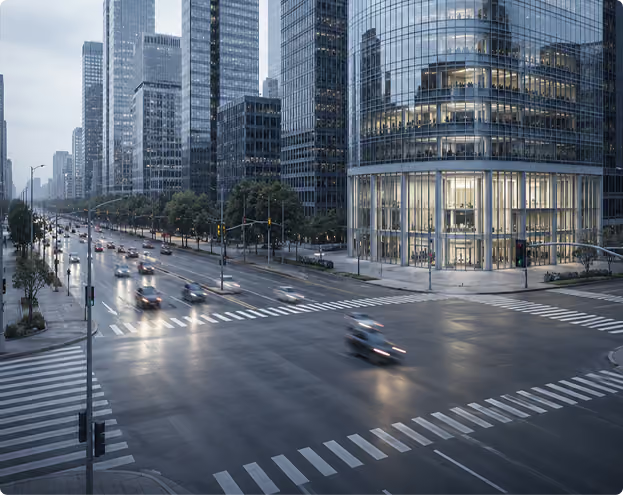
Cities are layering AI onto vast existing CCTV estates: traffic optimization, public-safety analytics, crowd management, incident detection and infrastructure monitoring.
From detection to understanding
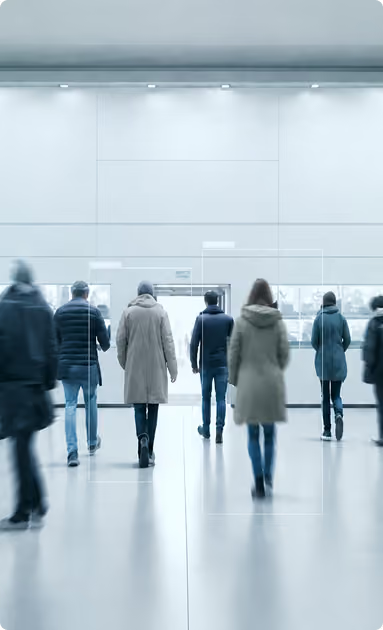
Video AI has matured from motion detection to genuine scene understanding, enabling far greater awareness of what is happening within every scene.

Video - the ultimate test
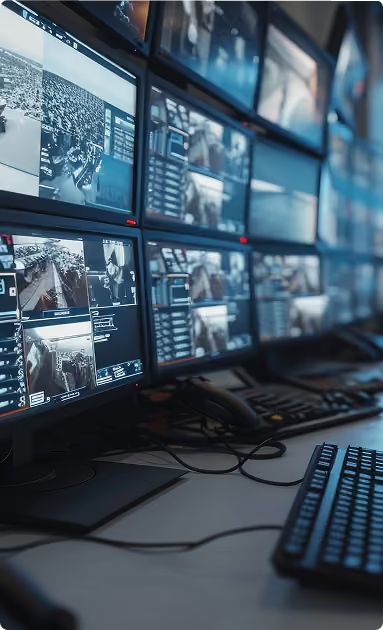
Video is the heaviest data workload, yet most footage captured is uneventful. Vision AI specialists must cut through the noise, without letting the noise cut through their capacity.


Traffic problems
Backhauling thousands of continuous video streams to a centralized cloud is economically and physically absurd
Bandwidth costs alone can dwarf the compute bill, and the energy spent moving footage that contains nothing of interest is pure waste.
Vision AI workloads are demanding, requiring high-throughput GPU inference, real-time processing, and low latency eg for facial recognition, object detection, and video analytics.
An alert that arrives thirty seconds late is an archive entry, not an intervention. And citizen-surveillance data is politically radioactive if it leaves the jurisdiction.
Governments and enterprises require AI processing to remain in-country while still achieving hyperscale-level performance.

.avif)


.svg)


The key to the smart city
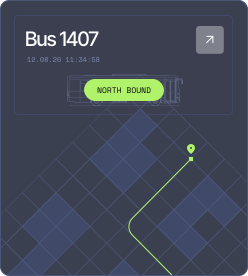
Edge video AI inverts the model: analyze everything locally, transmit only insight. Detect the stalled vehicle, the crowd surge, the unattended object, the infrastructure fault - in real time - and send a kilobyte of alert instead of a gigabyte of footage. Cities gain a live operational picture of themselves for the first time.

Why Radian Arc is a model citizen
This is the workload our architecture was born for. GPU nodes embedded in the carrier networks that already connect the cameras mean inference happens milliseconds from the lens, with backhaul reduced by orders of magnitude.
Orchestration packs hundreds of camera streams per GPU for maximum density; the control plane enforces city-defined privacy and retention policy at every node.
Measured in events detected per Watt, the only metric that matters for always-on video AI - a federated edge deployment doesn't just beat the hyperscaler model. It makes it look like a rounding error.
Radian Arc: More traffic alerts per Watt.

.png)

.avif)